
The Truth about Squats

By definition, a full squat is just below parallel, where the hip joint is lower than the knee joint. At the bottom of the squat, if you were to put a marble on your thigh, it should roll down towards your hip — not your knee.

In actuality, most people perform half squats or quarter squats (referring to the range of motion) for various reasons. Some can’t due to mobility issues, while others simply resist because they claim squatting to full depth is “bad for your knees and back.”

Fortunately, we can look to science — specifically a recent study published in the journal Sports Medicine1 — for a definitive ruling on the squat depth debate.

Researchers essentially did a review of all current literature on knee and back health, as it pertains to squat depth at various loads. The researchers reviewed a total of 164 articles and found some very interesting data. Not only are full depth squats not dangerous, they actually cause less stress on your knee joint and spine. “When compared with half and quarter squats, in the deep squat [less] knee joint and spinal joint stress can be expected.”

“Not only are full depth squats not dangerous, they actually cause less stress on your knee joint and spine.”

Noted in Scientific Study —

Supportive tissue (ligaments and tendons) will adapt to increased loads, and concerns about degenerative changes in the knee are unfounded.

At the turning point of a half squat, there is more compressive stress on the knee and a smaller support surface for the quadriceps tendon (when compared with a full squat).

Full squats do not have any negative effect on the stability of knee ligaments.

The spine adapts to squat training by A) increasing bone mineral density, increasing tensile strength of ligaments, and C) strengthening back muscles — this contributes to a protective effect.

When half squatting, a significantly greater load is necessary to create the same training stimulus (when compared to the full squat) — this requires MORE compressive force on the back and knee to produce the same effect.
What do you think of this post?
  • Awesome (12)
  • Interesting (8)
  • Useful (2)
  • Boring (0)
  • Sucks (1)

Exercise Selection

Bodybuilder-
In an attempt to “bring up their weaknesses” bodybuilders often opt for isolation exercises. Chest flyes, concentration curls and leg extensions are all part of the bodybuilder’s repertoire.

Additionally, since these isolation exercises work only one small area at a time, you must do many different exercises to get a full workout, which again leads to a greater time commitment.

Athletes-
Athletes, on the other hand, are more concerned with function. And since the body was not designed to have each muscle and/or movement pattern isolated, they rarely perform isolation exercises like bodybuilders do.

Instead, they focus on movements that engage the entire body, just like what would naturally happen during a sporting event.

These exercises have a huge metabolic cost and rev up your metabolism much more that a chest fly could even dream of doing. Also, because they work so many muscle groups simultaneously, they are very time efficient.

As you can tell, I favor the use of exercises that work the entire body over isolation movements. That being said, there are times, where an isolation exercise can be effectively used to supplement the use of the more result-producing exercises.

What do you think of this post?
  • Awesome (9)
  • Interesting (4)
  • Useful (3)
  • Boring (0)
  • Sucks (2)

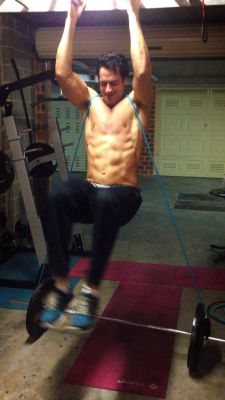
Pull ups with Resistance Bands

Bruno-Pullups-Bands

Athletes who performed band pull ups had a much greater increase in pull up strength and power compared to those who performed standard pull ups on a study by National Strength and Conditioning Association in 2004.

Ithaca College (Ithaca, New York) researchers found that athletes combining bands with pull ups, bench and squats increased strength by twice more than those using traditional free weights and also had an increase in muscle mass more than the athletes who only used free weights.

What do you think of this post?
  • Awesome (5)
  • Interesting (1)
  • Useful (3)
  • Boring (1)
  • Sucks (0)