How To Avoid Injury During Your Run

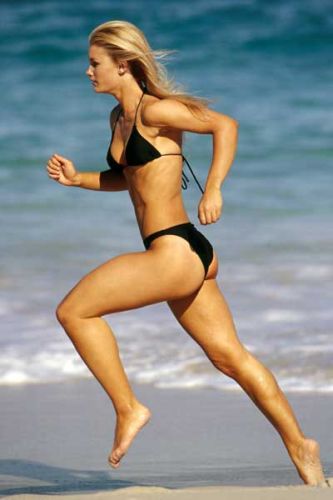
girlbeachrun

1. PROTECT YOUR POSTURE
Keep shoulders back and down, chest lifted, abs tight. Lean entire body slightly forward from ankles (don’t bend at the waist), allowing gravity to gently pull you forward.

2. KEEP EYES ON THE HORIZON
Look out ahead, rather than at the ground. Keeping your gaze up makes walking and running easier.

3. RELAX YOUR HANDS
Clenching your fists can send tension up your wrists and arms; loosen up by pretending to cup something fragile, like a potato chip or butterfly.

4. MAKE SMOOTH TRANSITIONS
In the final seconds of each walking interval, pick up your pace so when you switch to running, it feels easier than if you tried to walk any faster.

5. LAND MIDFOOT
Unlike walking, striking the ground with your heel when you run puts on the brakes. Aim to come down with the middle of your foot landing under you, then roll through smoothly.

6. SHORTEN YOUR STRIDE
Protect knees and absorb shock better by maintaining a short stride and keeping a slight bend in your knee as you land.

7. PICK YOUR FEET UP
Instead of pushing into the ground, which can fatigue muscles, focus on keeping legs relaxed and lifting feet up.
What do you think of this post?
  • Awesome (0)
  • Interesting (0)
  • Useful (0)
  • Boring (0)
  • Sucks (0)

Exercises for Great Looking Legs & Glutes

marinakatic

Several muscles make up the legs, but the four main muscles of the thighs are the quadriceps (quads, tops of thighs), bicep femoris (hamstrings, back of thighs), abductors (outer thighs) and adductors (inner thighs). The gastrocnemius and soleus muscles form the calf muscles. The buttocks’ largest muscle is the gluteus maximus (glutes). There’s no better way to shape these muscles than tried and true, basic exercises.

Squats

Most fitness experts and bodybuilders agree there is no better lower body exercise than squats. Squats work the quads, glutes and adductors.

Lunges

Intense stress is placed on all the muscles of the thighs and glutes of the working leg. The length of the lunge determines contraction in the thigh and hip. With a longer lunge, more emphasis is on the glute muscle.

Deadlifts

The Deadlift is a compound exercise targeting several muscle groups including the latissimus dorsi, trapezius, erector spinae, gluteals, hamstrings, quadriceps, and psoas (hip flexors). Your forearm muscles, which are involved in gripping the bar, are used to a lesser degree, as well as muscles involved in trunk stabilization such as your obliques.

Calf Raises

Calf Raises work the muscles of the calves, one of the densest muscles in the body and the most difficult to develop. Although genetics play a strong role in calf size, calf raises can stimulate and encourage muscle growth and definition.

What do you think of this post?
  • Awesome (0)
  • Interesting (0)
  • Useful (0)
  • Boring (0)
  • Sucks (0)