
Tire Flips

trim.1E84D7F2-FF6E-4E36-A813-C22D8440FFEC
image

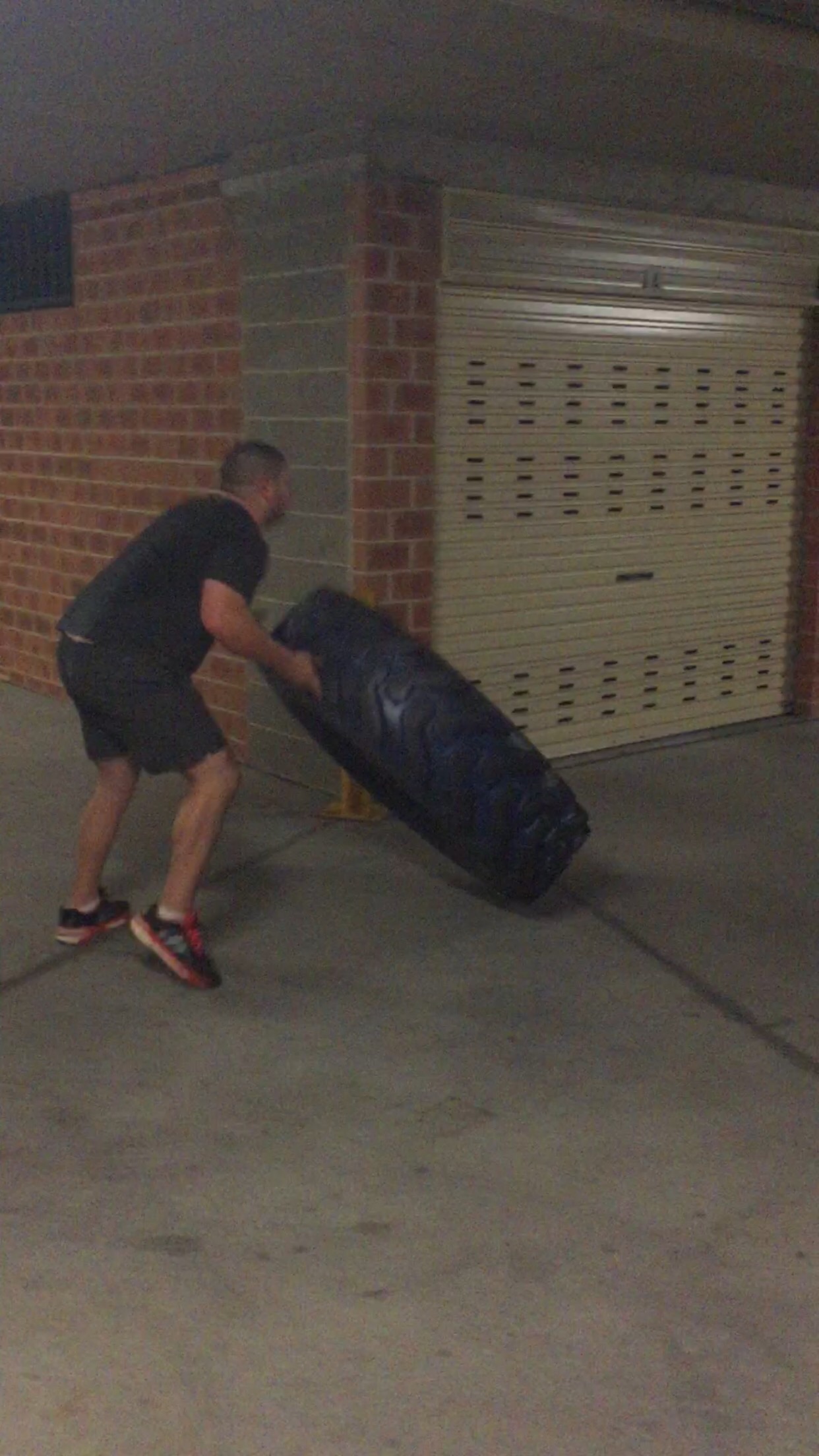
The first concept to consider is the fact that the tire flip is not a deadlift; it is more like a hack squat. The movement is generated solely from the lower body, the
arms merely lock onto the tire. Do not attempt to lift the tire with your arms or serious injury can occur.

To set up properly you want your arms slightly bent and in a comfortable position. Your feet should be back away from the tire and your chest up against it. Your
back is flat and your hips are low. Lockdown your upper body and drive from your legs to extend your hips, knees, and ankles. When you do this your hips should
be propelling the tire simultaneously upward and forward. Your body should remain close to the tire at all times as you quickly rotate your hands and follow through
until it is completely flipped.

Some tires are heavy and you may only be able to lift it waist high; at this point, drive one of your knees against the tire to prop it up until you can get your hands
turned and your hips adjusted to complete the flip. You can train tire flips in two ways: you can flip a heavy tire for strength and power production or go with a lighter tire to work more volume and train your endurance and conditioning.

What do you think of this post?
  • Awesome (12)
  • Interesting (3)
  • Useful (1)
  • Boring (0)
  • Sucks (0)

BFit Group Training Sessions

Elizabeth-Kate-Buckler

Anyone looking to achieve some great results? Make sure you try a BFit group sessions to go with your current or non current fitness regime. With only 3 sessions a week and at $10 a session you will not regret it. Results guaranteed within 2 weeks! Don’t believe it? Try us!!

https://www.facebook.com/pages/BFit-BrunosFitness/163400273733922

What do you think of this post?
  • Awesome (5)
  • Interesting (2)
  • Useful (4)
  • Boring (1)
  • Sucks (1)

Rep Range

BFit Mosman Personal Trainer

low reps (1 – 5), the adaptations that make you stronger are mostly neurological: You develop an increased ability to recruit more muscle fibers, you stimulate the higher threshold fibers that are not activated with high rep, low weight sets, you decrease neuromuscular inhibition, and there is increased coordination between the muscle groups. However, with low reps, the hypertrophy (size increase) of the muscle fibers is minimal.

In other words, reps under 6 make you stronger, but they don’t necessarily make you bigger because the strength gains come from adaptations in the nervous system – the muscle fibers and other muscle cell structures do not hypertrophy (enlarge). This explains why certain athletes, powerlifters and Olympic lifters can be wicked strong but they don’t look as strong as they are.

When you train with medium reps (6-12) the adaptations are more metabolic and cellular and only moderately neurological. This is why 6-12 reps is the range most often recommended for bodybuilding and hypertrophy. You get bigger and stronger in this rep range, but your strength gains are not maximal. This explains why some bodybuilders look stronger than they are (and why they are often the brunt of jokes made by powerlifters and weight lifters; i.e. “big, weak, slow, useless muscles”, ha ha).

What do you think of this post?
  • Awesome (7)
  • Interesting (2)
  • Useful (4)
  • Boring (1)
  • Sucks (0)