
About Bruno

Pain is only weakness leaving the Body!

Tips on how Middle Aged People Should Train

Use The Right Training Routine

A well periodized training routine that alternates between periods of higher volume/higher repetition (10-15 reps) work with periods of lower repetition/heavier weights (5-8 reps) will work best. Active recovery phases where training volume is dramatically reduced should also be incorporated. The training routine should not be more than 60 minutes long and frequency of body part training will depend upon individual recovery.

Use Proper Warm-Ups

Warming up is extremely important, and it becomes more important as we age. Ride a stationary bike first for 6-10 minutes, not in search of aerobic conditioning but with the goal of increasing your core body temperature. Alternatively you can also do abdominal training as a way to increase your core body temperature as well.

Perform The Right Exercise Techniques With The Proper Weight

Proper execution of exercise and proper lifting speed is crucial. The exercise form should never be sacrificed in the name of adding weight. Nothing good has ever come out of that combination. In addition, jerking the weight up and down not only affects how much the muscle is actually stimulated (so your muscle building results will be less), but also puts much of the stress on the joints, leading to unnecessary micro-trauma. So always choose a weight that allows for full control of the weight and a lifting speed that is steady and controlled on the way up and slower on the way down. Contracting the muscles at the top position also helps to provide maximum stimulation without unnecessarily having to use super heavy weights.

Ensure Rotator Cuff Health

One of the most common injuries in weight training is that of the rotator cuff. The reason for this is that as the shoulder muscle gets stronger, the rotator cuff gets weaker unless you train it directly with 3 sets of 15-20 repetitions of rotator cuff exercises. Some external rotations at the end of your chest or back workout will do the trick.
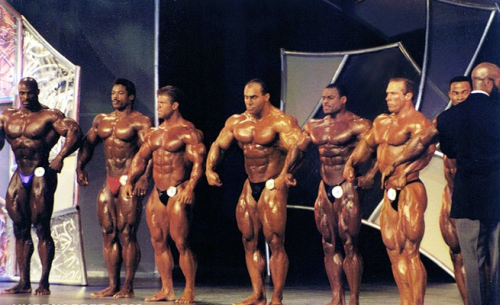
The truth about Bodybuilding Competitions

Juicer-Comp

I don’t think that there are any true natural bodybuilders taking part in any bodybuilding contests or natural bodybuilding contests these days, at least not in the contests at any significant level. The reason is very simple, they would be blown away from the stage by their doped fellow competitors. Yes, anabolic steroids and other drugs are that effective. Most so-called natural bodybuilders are using hormonal drugs such as anabolic steroids, growth hormone, insulin or prohormones during contest preparation, or have been doing so in the past to build their physique, especially the heavy weight competitors.

I think it is fair to state that since the 50’s, when testosterone and anabolic steroids became available to athletes, competitive bodybuilders have been using them consistently, especially the professionals. Most of nowadays professional bodybuilders started using hormonal doping products already as a teenager, and sometimes even as early as the age of 15. I seriously doubt whether competitive bodybuilding would ever have come off the ground if this hormonal doping would not have been available.

So far, there exist no contests for true natural bodybuilders, mainly because of 2 reasons: it is impossible to test whether a bodybuilder is TRUE (life-time) natural, and true natural bodybuilders simply don’t look impressive enough (not enough muscle mass and too much body fat compared to doped bodybuilders). And to be honest, I hope there will never be contests for true natural bodybuilders as there will always be cheaters showing up.

I believe that true natural bodybuilding is and should stay simply a healthy, sporty lifestyle. I approach it as a competition against myself, in which I try day after day to push my personal limits one step farther. I don’t believe there is any honor or money to win by true natural bodybuilders in terms of competing or becoming an idol.

Also note:
HGH! Insulin, thyroid meds, and HGH will all combine to produce a pretty damned effective fat-burning and muscle building cycle! You know what else? HGH is virtually undetectable on any sort of currently used drug-screening tests. HGH, Insulin, Thyroid meds, and IGF may also be used pretty safely by those who may be subject to drug screening tests.

Steps to Strengthening Your Rotator Cuff Muscles

The rotator cuff is a group of four muscles, supraspinatus, infraspinatus, subscapularis, and teres minor. They surround the shoulder joint and provide stability while the shoulder joint is moving. These muscles are extremely important in all shoulder movements, especially overhead and rotational. Knowledge about ways to strengthen these muscles can help improve function and prevent injuries.

Step 1

Begin with isometric contractions, where you make a muscle contraction without causing any joint motion. Push into a wall going forward, out to the sides, rotating inward and rotating outward.

Step 2

Use light weights to strengthening through the complete range of motion. Raise arm up in front of you, out to the side as if doing jumping jack, rotating outward and rotating inward. The rotation should be done with elbow bent and in standing/sitting or laying on your side.

Step 3

Increase resistance as you can tolerate, but research shows in oder to improve overall muscle strength you need to use 60-80% of one repetition maximum.

Step 4

Progress to diagonal and more functional motions that required higher level of stability. Do exercises that require you to elevate your shoulder by taking it across your body and then rotating inward or outward.

Step 5

Train the muscles ability to react quickly and improve power production. Performing activities such as throwing and catching require the shoulder muscles to react quickly and forcefully in order to slow the momentum of the throw.

Step 6

Preform shoulder strengthening activities in weight bearing position such as hands and knees, which requires complex shoulder girdle stability.

Step 7

Then progress these childbearing activities to be done on an unstable surface such as a Swiss ball or soft mat to challenge kinesthetic awareness.